Vehicle Transport: Open vs Closed Car Carrier — Which to Choose?
When a car needs to be transported from one end of Estonia to the other or delivered from abroad, the owner soon faces a choice: should they order vehicle transport with an open car carrier or a closed trailer? The choice affects both the price and how well the car is protected from the elements, road dust, and stone chips during transit. In this article, we explain the differences, advantages, and disadvantages of both options and provide practical tips on how to find a suitable carrier and reasonable price in Estonia.
What is an Open Car Carrier?
An open car carrier is the most common method of transporting vehicles. The vehicle is secured on an open platform or trailer and travels to its destination under the open sky. This method is used for the majority of new cars being transported from factories to dealerships worldwide — it is a proven, fast, and economical solution.
The main advantages of an open carrier are lower prices, a wider selection of carriers, and usually faster availability. Since the platform often accommodates multiple vehicles at once, the fuel and labor costs are shared among several cars, keeping the price lower for the customer.
- Cheaper than closed transport
- More available carriers and flexible deadlines
- Suitable for most standard vehicles
What is a Closed Car Carrier?
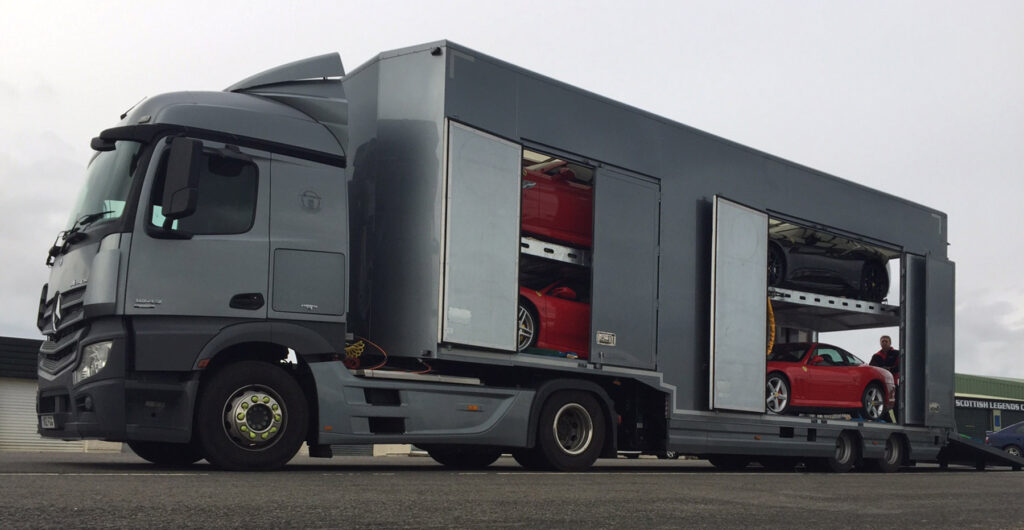
A closed car carrier is a fully covered trailer or van where the vehicle is loaded and protected from the surrounding environment during transport. The car is shielded from rain, snow, salt, road dust, and flying stone chips from oncoming traffic, and it is also not visible to curious onlookers.
Closed transport is more expensive but offers maximum security. Many closed carriers are equipped with soft fastening systems, hydraulic lifts, and low loading angles, which are important for vehicles with low ground clearance. This is the preferred choice when the value or condition of the car justifies the additional cost.
Which Vehicle to Choose for Each Option?
The decision primarily depends on the value, age, and condition of the car. Generally, a simple logic applies: the rarer or more expensive the vehicle, the more it is worth considering closed transport.
- Standard used car — an open carrier is perfectly adequate and the most reasonable choice. A bit of dust is not a problem.
- New, luxury, or sports car — consider a closed carrier to avoid stone chips, scratches, and paint damage. Maintaining the original color and flawless appearance pays off in terms of value.
- Classic or collectible car — closed transport is strongly recommended. Old paints and chrome details are particularly sensitive to weather and salt.
- Non-driving or damaged car — here, the loading capacity (winch, platform) matters more than the presence of a cover. Confirm with the carrier that the vehicle can be loaded and unloaded without moving under its own power.
Price Difference and Security
Open transport is generally significantly cheaper — closed transport can cost twice as much or more, depending on the distance, vehicle dimensions, and region. The price difference arises because closed carriers accommodate fewer cars, are more expensive to acquire and maintain, and require more careful handling.
In terms of security, the difference mainly lies in weather protection and road safety. An open carrier may allow the car to accumulate road dust, dirt, salt spray, and snow in winter — these are usually easily washed off. A closed carrier protects against stone chips, waxed surfaces, and paint damage. The quality of fastening — whether the car is properly secured with straps — is equally important in both cases and depends on the diligence of the carrier.
Insurance and Loading
Regardless of whether you choose an open or closed carrier, it is essential to check the carrier's cargo insurance. Always ask if the car is insured during transport and to what extent. Before loading, take photos of the car from both sides and document any existing scratches — this provides evidence in case of disputes.
The loading method is particularly important for non-driving vehicles. Inquire whether the carrier has a winch, hydraulic platform, or ramp that allows the car to be pulled on without moving under its own power. For low-clearance sports cars, ask about the loading angle and soft fastening straps to avoid damage to spoilers and the undercarriage.
How to Find a Suitable Carrier and Price in Estonia?
There are many car transport service providers in Estonia, and prices can vary significantly for the same route. To avoid overpaying or falling into the hands of an unreliable carrier, it is worth following a few simple principles.
- Describe the vehicle's make, model, dimensions, and whether it drives under its own power in your inquiry.
- Indicate whether you want open or closed transport and the desired timeframe.
- Request multiple quotes at once to see the actual market price level.
- In addition to price, compare insurance, loading capacity, and carrier feedback.
With CargoDetect, you can make a single transport inquiry and let independent carriers submit offers to you — this way, the right service reaches you, not the other way around. Posting an inquiry is free, and you only pay a service fee if the order is actually fulfilled.
Post your vehicle transport inquiry on CargoDetect today — it’s completely free. Describe the car and the desired transport method (open or closed), receive multiple offers side by side, and choose the best price and carrier for you. This way, you save time and money and gain peace of mind that your car will arrive safely.